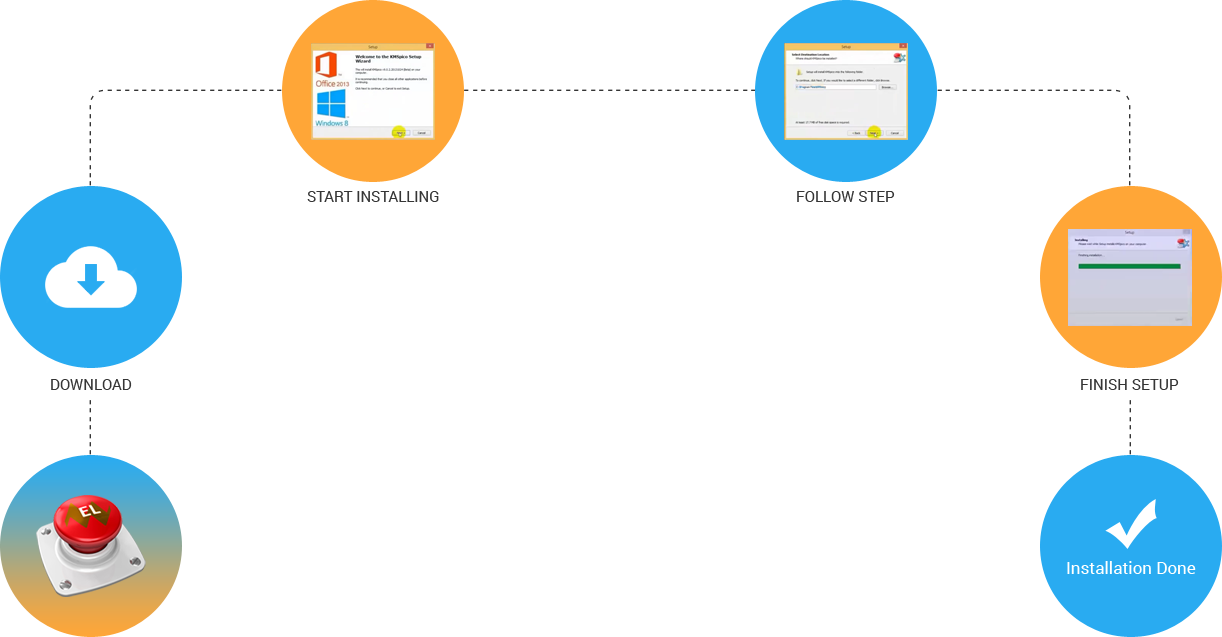
KMSpico is the most successful, frequently updated and 100% clean tool to permanently activate any version of Windows or Microsoft office within matter of seconds.
“KMS” (Key Management Service) is a technology used by Microsoft to activate software deployed in bulk (e.g., in a corporate environment). What KMSpico does is to replace the installed key with a volume license key, create an emulated instance of a KMS server on your machine (or in previous iterations of the software, search for KMS servers online) and force the products to activate against this KMS server.
KMS activation only lasts for 180 days after which, it must be activated again. However, by using KMSpico, an activation service is created which runs KMSpico twice a day to reset this counter.
GetKMSPico.com is in no way associated with Microsoft Corporation.

In short, a line like this is small but dense: operational metadata that, when read with care, reveals a system’s shape and a team’s habits. It’s the sort of trace that, on its own, makes little noise — but when stitched into surrounding logs, dashboards, and human memory, becomes a vital thread in the tapestry of system understanding.
At first glance, DASS-341 looks like an issue or ticket number: compact, trackable, and intentionally opaque to anyone not in the project. Such identifiers carry more than administrative weight; they encode a workflow. A ticket like DASS-341 implies a history — an origin story of a problem report or feature request, a set of people who touched it, and a resolution trail that can be read in timestamps, commit messages, or CI results. In engineering cultures, those numbers become shorthand for months of discovery, iterations, and trade-offs.
Finally, the tag Min — minimal, minute, or monitoring — acts as a clue about scale or intent. It could mark a minimal reproducible case, a “minified” output, or a monitoring probe that intentionally does as little as possible while still exercising a code path. In debugging, isolating the “min” case is a craft: strip away the noise until the bug’s silhouette appears. In production, a “Min” probe can be a canary, a low-cost health check that trades depth for frequency. DASS-341 Javxsub-com02-16-45 Min
The numeric string 02-16-45 reads like a time-of-day stamp, a short-run duration, or a version snippet. Read as a clock time it narrows the event to a particular minute in an operational timeline; read as a duration it hints at a surprisingly tiny execution window; read as three version components it implies iterative refinements. Time is central to observability: a single timestamp lets disparate logs be correlated, revealing causal chains and exposing race conditions or transient failures that only appear under precise timing.
Javxsub-com02 reads like a module label that mixes technology and environment. "Jav" hints at Java, JVM-based tooling, or a Java wrapper; "xsub" could point to a cross-subsystem interface, a subscription mechanism, or a text-processing submodule; "com02" evokes a communication channel, a container name, or simply the second instance in a cluster. The composite name reflects a reality of modern systems: they’re built from stitched-together pieces, each with its specialized semantics and deployment topology. Names like this tell engineers where to look, which logs to tail, and which configuration maps to inspect. In short, a line like this is small
Beyond diagnosis, there’s an organizational lesson embedded here. Good telemetry and naming conventions save time and attention. A well-structured identifier acts as a folded map of context: who owns the component, where it runs, and what kind of investigation is appropriate. Poorly named artifacts, by contrast, leave rescuers wandering in the dark. The compact label “DASS-341 Javxsub-com02-16-45 Min” nudges teams toward clarity: keep tickets granular, name services predictably, record precise times, and capture minimal repros for fast iteration.
The title reads like a small piece of a larger technical log: an identifier (DASS-341), a module or process name (Javxsub-com02), a timestamp (02-16-45), and a short label (Min). Taken together, it suggests a snapshot from a monitoring or build system — an event, a test run, or a brief summary of a component’s status. That functional framing is a useful starting point for thinking about what this string can reveal and how to turn it into a meaningful narrative. Such identifiers carry more than administrative weight; they
Taken together, the whole label reads like a compact story: ticket DASS-341, exercised against the Javxsub-com02 component at 02:16:45, using a minimal test or probe. That story invites questions that shape next steps: what triggered the ticket? Did the minimal probe fail or succeed? Are there correlated traces from neighboring components? How many retries, what error codes, and which configuration values were in play? The components of the label are bookmarks into a richer diagnostic narrative.
Now you should know that the KMSPico v10 was great and the program can really help in activating the Windows 8/8.1. So, what is next? Yes…get the software and install it to the PC that you wish to be activated.